Becof NitroFix™
- Contains no chemicals
- Natural, biological ingredients
- Gum arabic adhesive included
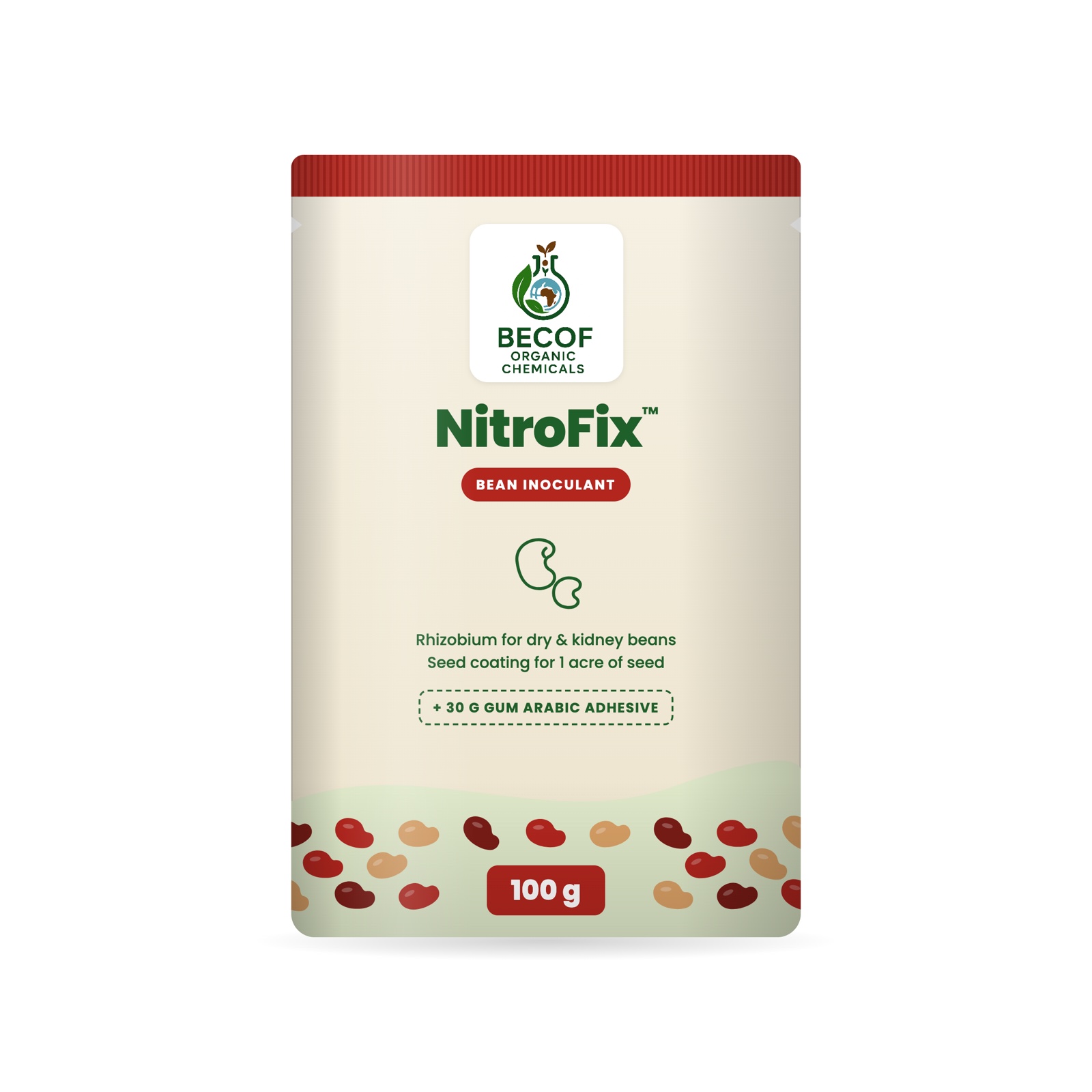
Rhizobium inoculant for dry beans and kidney beans. One 100 g pack coats the seed for one acre — gum arabic adhesive included.
📦 KES 500 delivery anywhere in Kenya · Free on orders over KES 30,000
How much do I need?
Rate: 100 g per acre of seed (15–25 kg of seed). When: Coat the seed just before planting, and plant within 4 hours. NitroFix is for common dry beans and kidney beans. Don't top-dress with nitrogen after planting.
Enter your farm size to see how much you need and the best-value packs.
Description
Becof NitroFix™ Beans Inoculant (100 g) — includes free gum arabic adhesive for professional seed coating. Are your dry beans or kidney beans giving you poor yields? Do you apply expensive top-dressing fertilizers only to watch them wash away with the rain? Your beans have a secret superpower: they can capture nitrogen from the air. But they need specific rhizobium bacteria to form root nodules. Without these bacteria, your beans starve for nitrogen — the plants stay yellow and the pods stay small. Becof NitroFix™ contains a highly concentrated powder of live rhizobium bacteria specifically formulated for common dry beans and kidney beans. When you coat your seeds with NitroFix before planting, the bacteria attach to the emerging roots, form nodules and start pulling nitrogen from the air. Your plants grow faster, greener and more productive. Every 100 g pack comes with a complimentary 30 g sachet of gum arabic adhesive, so the inoculant sticks perfectly to your seeds. No waste, no uneven coverage, and no need to buy a separate sticker. Product highlights - Superior yields through natural nitrogen fixation: the live rhizobium bacteria form healthy root nodules that convert atmospheric nitrogen into a form your beans can use. One acre of inoculated beans can fix 50 to 100 kilograms of nitrogen per season. - Cost savings on nitrogen fertilizers: with NitroFix inoculation you can reduce or eliminate CAN and urea top-dressing. Apply only a starter dose of DAP or NPK at planting and let the bacteria supply the rest. - All-in-one kit: the included 30 g gum arabic adhesive coats every seed evenly. One pack, everything you need. - Crop resilience for drier seasons: inoculated bean plants develop more extensive root networks that reach water deeper in the soil, so your crop survives dry spells better. - Improved grain quality for better prices: well-nodulated plants produce plump, uniform grains with excellent colour. - Safe and easy to use: NitroFix contains no chemicals and is harmless to humans, animals and beneficial insects. Coating takes only a few minutes per acre. - Long-term soil health: rhizobium bacteria improve soil biology. Each season you inoculate, the bacterial population in your soil grows. Why dry beans and kidney beans need inoculation Beans are legumes, like peas, cowpeas and groundnuts, and live in partnership with rhizobium bacteria in their root nodules, where nitrogen from the air is converted into ammonia the plant uses to make proteins and chlorophyll. But the strain that works best with dry beans is not present in all soils — especially fields that have not grown beans recently. Inoculation puts a high concentration of the right strain directly on the seed, so nodules form early and the plants never experience nitrogen stress. NitroFix compared with CAN or urea - Nitrogen source: free from the air (NitroFix) vs manufactured and energy-intensive. - Application: once at planting vs several times per season. - Risk of leaching: none vs high — rain washes nitrogen away. - Soil health: improves soil biology long term vs can acidify soil over time. - Grain yield increase: 20 to 40 percent vs 10 to 20 percent when used alone. - Nodulation: abundant pink nodules vs few or no nodules. The two work best together: a small starter dose of DAP or NPK at planting for phosphorus, and NitroFix for nitrogen. Storage and handling Unopened packs: store in a cool, dry place away from direct sunlight, ideally below 25°C, and away from chemicals, fertilizers and strong-smelling products. Stored correctly, an unopened pack remains viable for 6 to 12 months. Opened packs: use the entire pack at once — once opened, the bacteria die within a few days. Plan to use the whole 100 g pack on one acre. Transport: keep the pack out of the sun and never leave it in a hot car. The gum arabic adhesive is stable and needs no special handling. Frequently asked questions Can I use NitroFix on cowpeas or green grams? NitroFix Beans is formulated for common dry beans and kidney beans. For other legumes, ask us about crop-specific inoculants. Is the 30 g of gum arabic enough for one acre? Yes — mixed with 250 ml of water it makes enough adhesive for 15 to 25 kg of bean seed. Can I mix NitroFix with fungicides or insecticides? Do not mix them directly — many pesticides kill the bacteria. If you must treat seed with a fungicide, apply it first, let it dry completely, then apply NitroFix. Will NitroFix work in dry conditions? The bacteria need moisture to move from the seed to the root. Water adequately after planting; in a dry spell, irrigate immediately after planting. How soon will I see results? Healthier, greener plants within 2 to 3 weeks of emergence. At 3 to 4 weeks, dig up a plant: pink or red nodules on the roots show active nitrogen fixation. Can I use NitroFix on organic farms? Yes. NitroFix contains only natural, live bacteria and is suitable for organic farming systems. The gum arabic adhesive is a natural product from acacia trees.
Usage Instructions
Step 1: Gather your materials - Becof NitroFix™ Beans Inoculant (100 g pack) and the 30 g gum arabic sachet included in the pack. - Bean seed for one acre (about 15 to 25 kg, depending on variety). - A clean plastic bucket or basin — never metal, which can kill the live bacteria. - Clean, non-chlorinated water at room temperature (borehole, well or rain water; tap water must stand open for 24 hours first). - A measuring cup, gloves (recommended), and a clean sack or plastic sheet for drying. Step 2: Prepare the gum arabic adhesive Pour the 30 g sachet into a clean container, add 250 ml (one cup) of clean, room-temperature water and stir until fully dissolved. Let it stand for 5 minutes. Never use hot water — heat kills the bacteria. Step 3: Moisten the seeds Put the seed in the plastic bucket and add the adhesive little by little, stirring constantly, until every seed is slightly damp with no liquid pooling at the bottom. One acre of seed takes about 200 to 250 ml of adhesive. Do not over-wet the seed. Step 4: Add the NitroFix powder Sprinkle the whole 100 g pack evenly over the moistened seed and mix for 2 to 3 minutes until every seed has a uniform coating. Uneven coating means uneven nodulation. Step 5: Dry the coated seeds Spread the seed in a thin layer on a clean sack or plastic sheet in a cool, shaded, well-ventilated place — never in direct sunlight. Dry for 10 to 15 minutes, until the coating is dry to the touch but not hard. Step 6: Plant immediately Plant the inoculated seed straight away — within 4 hours at most. If you cannot plant everything at once, keep the seed in the shade under a moist sack. Step 7: Follow good agronomic practices - Plant 3 to 5 cm deep, in rows 45 to 60 cm apart with 10 to 15 cm between plants. - Water adequately after planting so the bacteria can reach the emerging roots. - Apply a starter dose of DAP or NPK at planting (50 to 100 kg per acre), placed below or beside the seed — not mixed with it. - Do not apply nitrogen fertilizer after planting: extra nitrogen stops the plant forming nodules. - Keep the crop weed-free, especially in the first 4 to 6 weeks. Crucial warnings - Do not mix inoculated seed with chemical fertilizers in the same container. - Do not expose inoculated seed to direct sunlight. - Do not use hot or chlorinated water. - Do not store leftover inoculated seed — discard any not planted within 4 hours. - Do not use expired inoculant; check the manufacturing date on the pack. - Do not mix NitroFix with chemical seed treatments. If you must use one, apply it first and let it dry completely before applying NitroFix.